Len Lye Centre and the Govett-Brewster Art Gallery
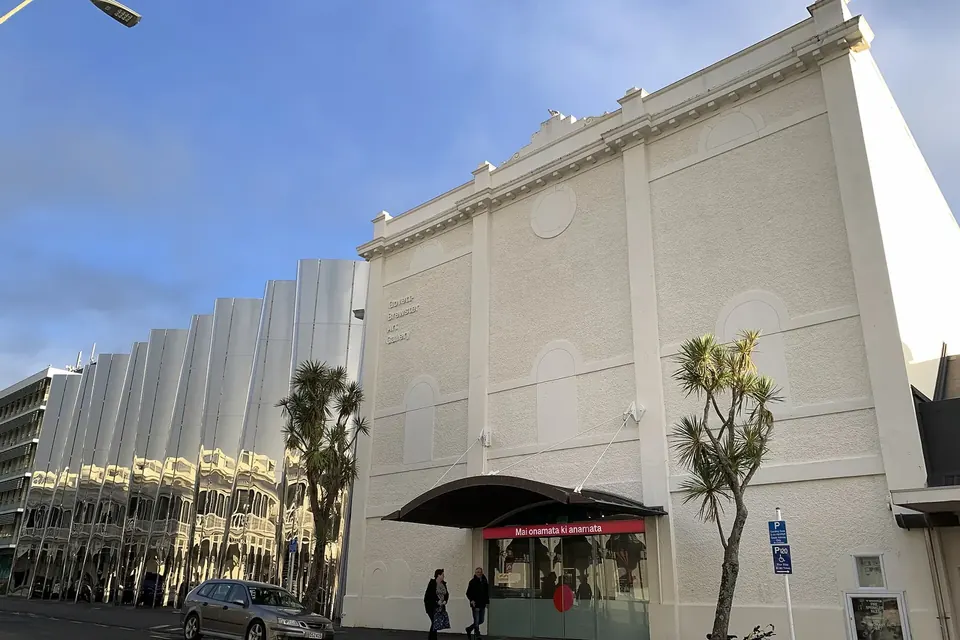
New Plymouth is a small city with an unusually strong contemporary art scene, and the reason stands on Queen Street: the Govett-Brewster Art Gallery and, joined to it, the Len Lye Centre, the first gallery in New Zealand dedicated to the work of a single artist. Its mirror-steel facade has become one of the most recognisable modern buildings in the country.
Who was Len Lye?
Len Lye was born in Christchurch in 1901 and spent most of his working life abroad, first in London and from the 1940s in New York. He was a restless experimenter. In the 1930s he made some of the first films created without a camera, painting and scratching images directly onto celluloid; works such as A Colour Box (1935), made for the British General Post Office film unit, are still studied by animators. Later he turned to what he called "tangible motion sculpture": steel rods, loops and strips set in motion by motors so that they whip, sway and resonate, often with startling sound.
Lye imagined his sculptures on a vast scale, far larger than the technology of his time allowed. Before his death in 1980, he and his supporters set up the Len Lye Foundation to look after his work and to help build the larger pieces he had designed. The foundation's collection and archive were placed with the Govett-Brewster in New Plymouth, which had shown his work and championed it since the 1970s.
The Govett-Brewster Art Gallery
The Govett-Brewster opened in 1970, funded by a bequest from Monica Brewster, a member of a prominent New Plymouth family, who wanted the city to have a gallery of contemporary art. From the start it focused on new work from New Zealand and the Pacific Rim rather than building a traditional historical collection. That focus continues: the gallery runs a changing programme of exhibitions by living artists, alongside its Len Lye holdings.
The Len Lye Centre
The Len Lye Centre opened on 25 July 2015 as an extension of the gallery. Designed by Pattersons Associates, led by the architect Andrew Patterson, it is wrapped in tall panels of highly polished stainless steel that curve in and out like a theatre curtain, reflecting the sky and the street. Inside, the centre has galleries designed to accommodate large, noisy kinetic works, an archive, an education space and a cinema that screens Lye's films and other programmes.
Not every work is in motion at all times. Many of Lye's sculptures are fragile and are run at scheduled times, often announced in the gallery on the day. If seeing a particular work in action matters to you, ask at the front desk when you arrive.
Len Lye in the city
Lye's influence extends beyond the gallery walls. The 45-metre Wind Wand on the foreshore, a few minutes away on foot, was built from his designs and erected in 2000; it bends in the breeze and glows red at night. It stands on the Coastal Walkway, so a visit to the centre combines naturally with a walk along the waterfront.
How to look at a kinetic sculpture
Lye's moving works can be puzzling at first sight: a bare steel strip or a cluster of thin rods standing still in an empty room. The point is the motion and the sound. When a work runs, a motor flexes or spins the metal through a programmed sequence, and the steel bends, shimmers and sings in ways that are hard to predict even after watching several cycles. Stand back far enough to see the whole movement, then move closer to hear how the sound changes. Lye wrote that he wanted people to feel motion in their own bodies, almost as a dancer would; many visitors find that the works make more sense the longer they watch. The films, shown in the cinema and sometimes in the galleries, use the same language of rhythm and line in colour and light.
Planning a visit
- Location. The gallery is on Queen Street in central New Plymouth, close to Puke Ariki and the waterfront. There is street and public parking nearby.
- Admission. Entry arrangements, including any charges for visitors from overseas, are set by the gallery and have changed over time; check its website before visiting.
- Time needed. Allow at least an hour, longer if a film programme or a kinetic demonstration is scheduled.
- Accessibility. The building has step-free access and lifts between levels.
- With children. The movement and sound of the kinetic works often fascinate younger visitors, but some pieces are loud; staff will advise.
Other culture in New Plymouth
Puke Ariki, beside the waterfront, combines the regional museum and the city library, with permanent galleries on Taranaki's natural and human history, including Māori taonga and the story of the nineteenth-century land wars in the region. Further afield, the summer programme in Pukekura Park and the Bowl of Brooklands brings concerts, theatre and the festival of lights. In South Taranaki, Tawhiti Museum near Hāwera, covered in our Surf Highway 45 guide, takes a very different, hands-on approach to local history.
Sources
- Govett-Brewster Art Gallery / Len Lye Centre, history and visitor information: govettbrewster.com.
- Len Lye Foundation, biography and works: lenlyefoundation.com.
- Roger Horrocks, Len Lye: A Biography, Auckland University Press, 2001.
- Te Ara, the Encyclopedia of New Zealand, "Lye, Leonard Charles Huia": teara.govt.nz.
- New Zealand Institute of Architects, award citation for the Len Lye Centre (2016).